Puerto Madero And Puente De La Mujer: What Is Free
Puerto Madero is the newest-looking corner of Buenos Aires, and almost everything worth seeing from the outside costs nothing: the docks, the bridge, the ecological reserve on its doorstep.
Short answer
Yes, Puerto Madero is free to visit. The docks, the Puente de la Mujer footbridge and the neighbouring Reserva Ecologica Costanera Sur cost nothing to walk. The Reserva is open Tuesday to Sunday, 8:00 to 19:00 in the November to March summer schedule, and closed Mondays. What costs money is everything indoors: restaurants, the ferry boats, and museum entries elsewhere in the city.
Part of the Free Things To Do In Buenos Aires guides hub, this one covers the dockside district of Puerto Madero and the Puente de la Mujer.
Quick Facts
| Question | Answer |
|---|---|
| Is Puerto Madero free to visit? | Yes, the whole district is open public space, free to walk |
| Is Puente de la Mujer free? | Yes, the footbridge is a free open public space |
| What is free nearby? | Reserva Ecologica Costanera Sur, free for all visitors |
| Reserva opening hours | Tuesday to Sunday, 8:00 to 19:00 in the Nov to Mar summer schedule |
| Reserva closing day | Mondays (also 1 May, 25 Dec, 1 Jan, and in bad weather) |
| What costs money at Puerto Madero | Restaurants and businesses; boats; the Tigre and Colonia ferries |
| Nearest free walk platform | GuruWalk and freetour.com, both with walks in central Buenos Aires |
Puerto Madero is the odd one out among Buenos Aires neighbourhoods. Where San Telmo runs on cobblestones and Recoleta on marble mausoleums, this district is built on recycled docklands, with brick warehouses on one side of the water and glass towers on the other. It is also, unusually for a district this polished, almost entirely free to see. The Free Things To Do In Buenos Aires directory treats it as one of the city's best value walks, because the price of admission to the whole spectacle is zero.
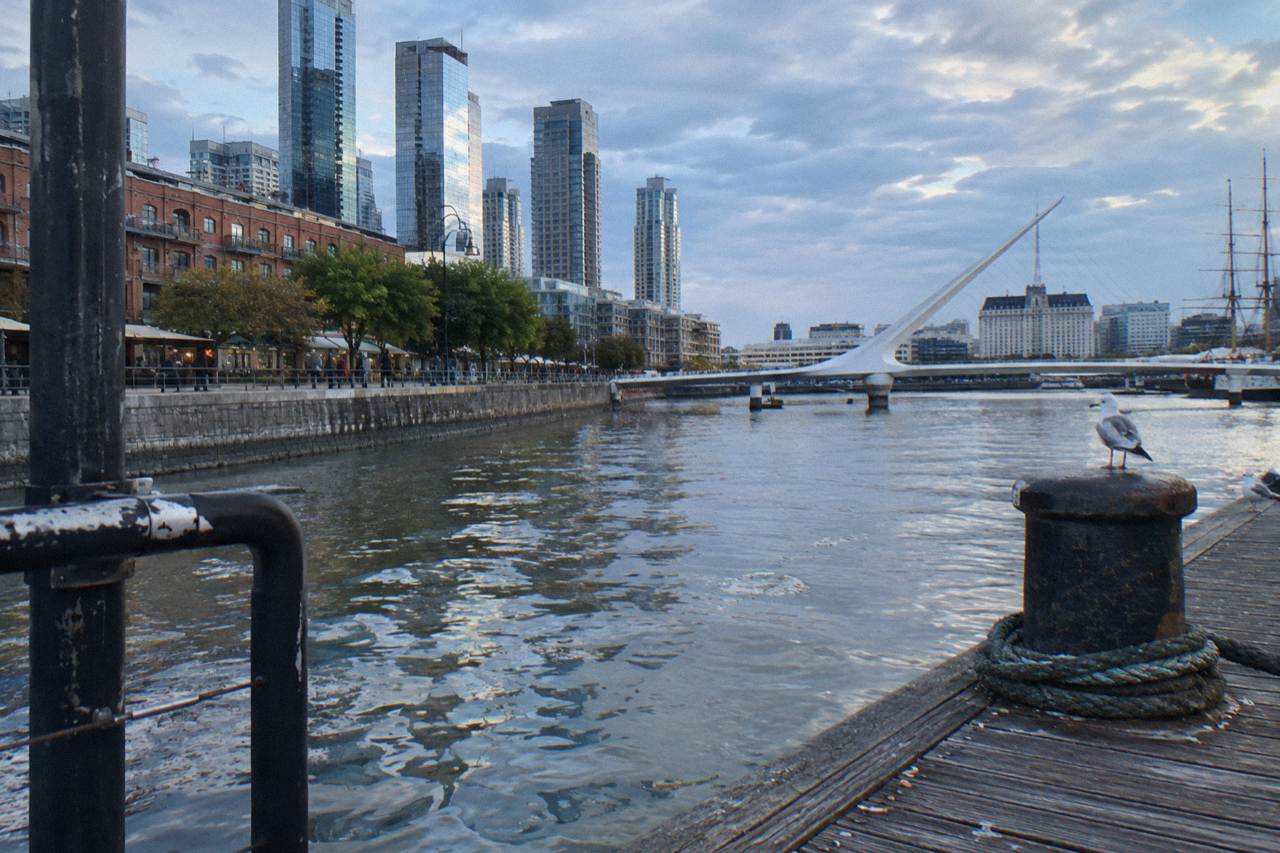
The strait facts first, then the detail. The Puente de la Mujer, the rotating white footbridge that has become the postcard image of the district, is a free open public space, listed as such in the city's own official details. The docks around it are public walkways. The Reserva Ecologica Costanera Sur, the green belt that begins where the district's eastern edge runs out, is free for all visitors on the days it is open. What is paid is everything that happens indoors or on the water: the restaurants that line the docks, the boat rides, and the ferries that leave from nearby terminals. This guide separates those two halves cleanly, and points to the free walking tours that pass through or start close by.
Is Puerto Madero Free To Visit?
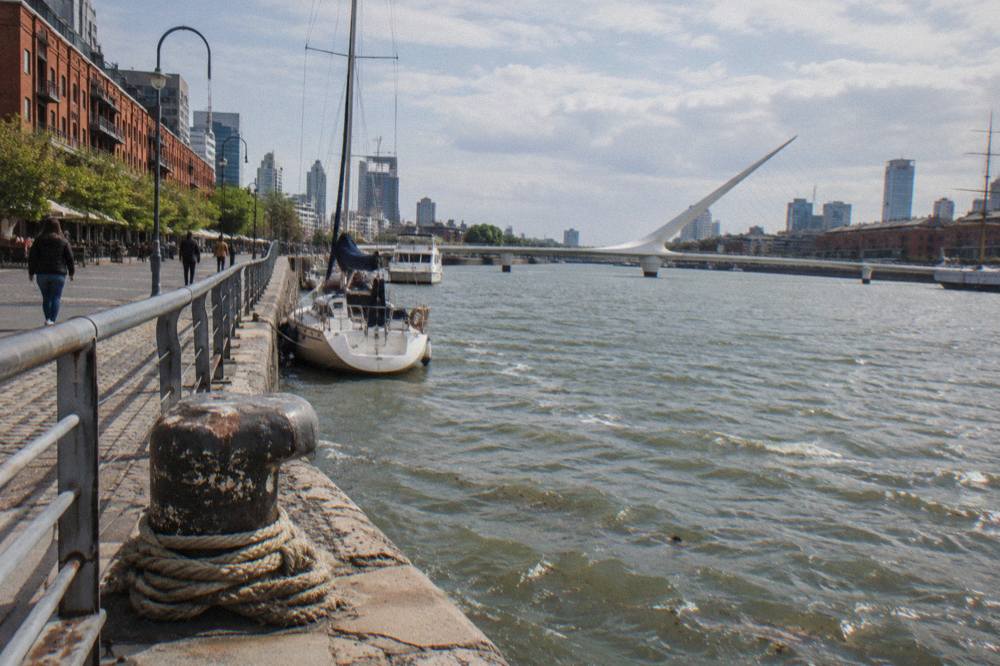
Yes, Puerto Madero is free to visit, full stop. The district is open public space: the dockside promenades on both sides of the water, the four pedestrian bridges that cross them, and the Puente de la Mujer itself cost nothing to walk, at any hour, for anyone. There is no gate, no ticket office and no resident-versus-visitor split anywhere in the neighbourhood. The only paid things are the businesses operating inside it. A free walk meets in this neighbourhood: Costanera Sur Nature Walk.
That last clause matters, because Buenos Aires is a city where "free" often comes with a residency condition attached. The city museums, for example, are free on Wednesdays only for Argentine residents with DNI, and the Cementerio de la Recoleta is free for residents while foreign visitors pay. Puerto Madero carries none of that. It is streets, bridges and water, and streets, bridges and water do not check passports. A visitor on any budget can walk the full length of the district, cross the bridge, photograph the towers and the old cranes, and spend nothing.
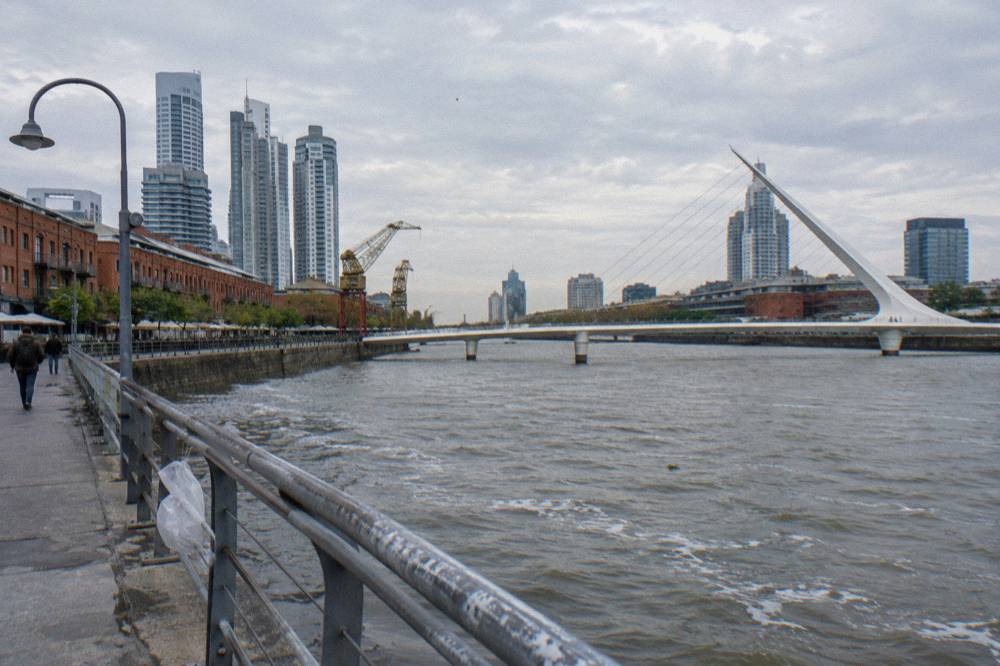
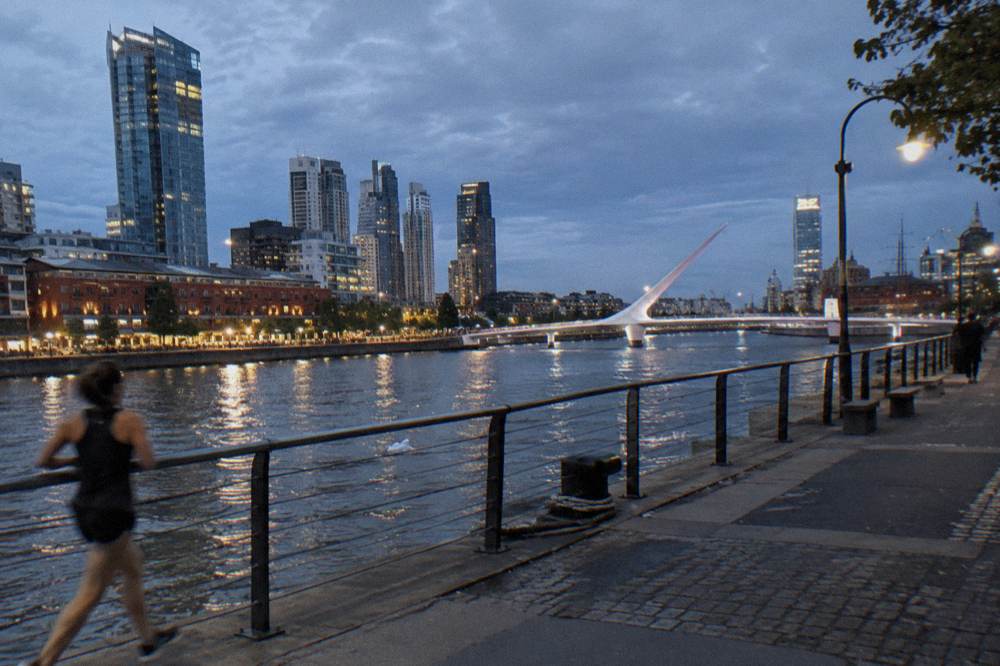
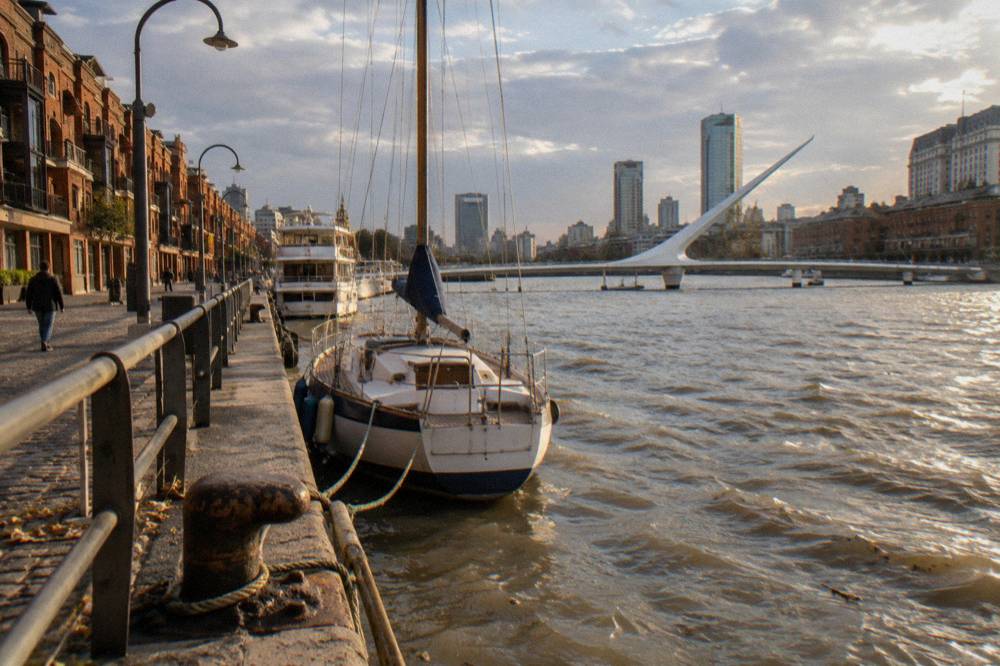
The district's shape helps. Puerto Madero is a narrow rectangle of docks, originally built as the city's cargo port and later redeveloped into housing, offices and restaurants, and it is entirely walkable from one end to the other. The western side keeps the brick warehouses of the original port, now converted; the eastern side is the newer build, fronted by the Parks and the ecological reserve. The Puente de la Mujer sits roughly in the middle, connecting the two halves across the water at the level of the dock's central basin.
Two practical notes complete the picture. First, the district has no closing hours of its own, but the Reserva Ecologica next door does, so anyone planning to combine the docks with the reserve should build the day around the reserve's schedule rather than the promenade's. Second, because everything free here is outdoors, the weather matters more than the wallet: the city's tourism pages and the national weather service at smn.gob.ar are the places to check before committing to a long open-air afternoon. The reserve in particular closes in bad weather, which the city's own page on the Reserva Ecologica Costanera Sur states plainly.
What Is Free Around Puerto Madero?
The free list at Puerto Madero is the docks and promenades, the Puente de la Mujer, and the Reserva Ecologica Costanera Sur. The reserve is the biggest free attraction on the district's doorstep: free for all visitors, open Tuesday to Sunday and holidays, 8:00 to 19:00 under the November to March summer schedule, and closed Mondays. Add the free sight of the bridge itself and the free waterfront on all sides.
GuruWalk
Most walks here, run by independent guides
Pay what you want
freetour.com
A smaller set, mostly Spanish-led
Pay what you want
The Puente de la Mujer deserves its own paragraph, because it is what most people come to photograph. The bridge is a cantilevered swing bridge with a single inclined mast, and its white profile against the dock water is the standard image of modern Buenos Aires. As a free open public space it can be crossed as many times as a visitor likes. The GuruWalk listing for it claims nothing beyond that: no viewing deck, no fee, no hours. It is simply a bridge, and a good one.
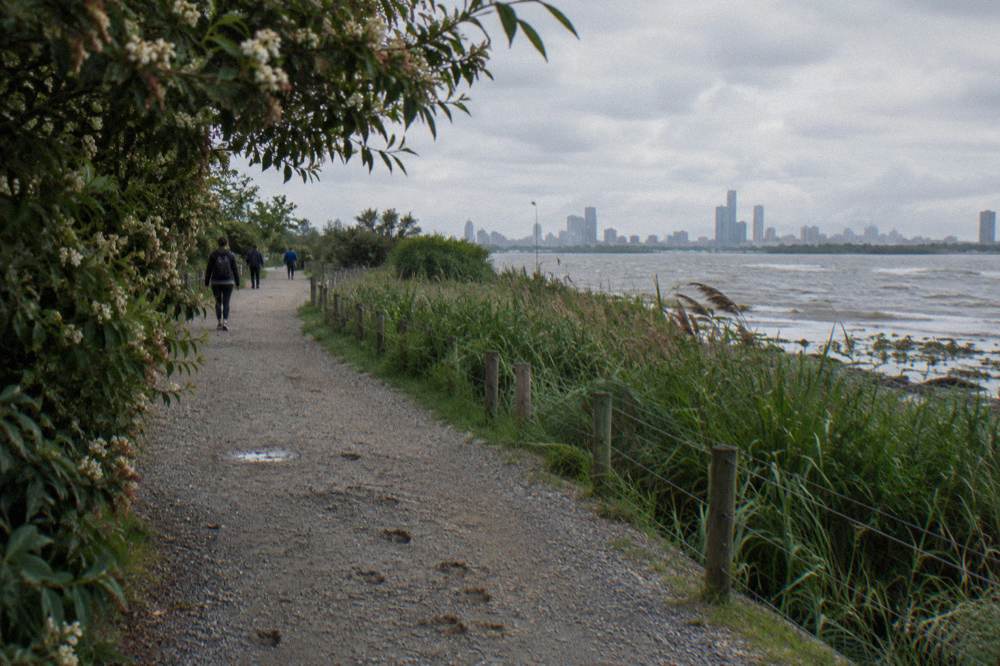
The Reserva Ecologica Costanera Sur is the heavyweight on the free list. It sits directly east of Puerto Madero, on land reclaimed from the river, and it functions as the district's back garden: walking and cycling trails through wetland and woodland, with the river on one side and the skyline on the other. Entry is free for everyone, resident or foreign, and the schedule is published by the city: Tuesday to Sunday and holidays, with the summer hours of 8:00 to 19:00 in force from November to March. It closes Mondays, plus 1 May, 25 December, 1 January, and in bad weather. A dedicated Costanera Sur reserve guide covers the trails and the birdlife in detail. One of the free walks starts in this part of the city: Costanera Sur Nature Walk.
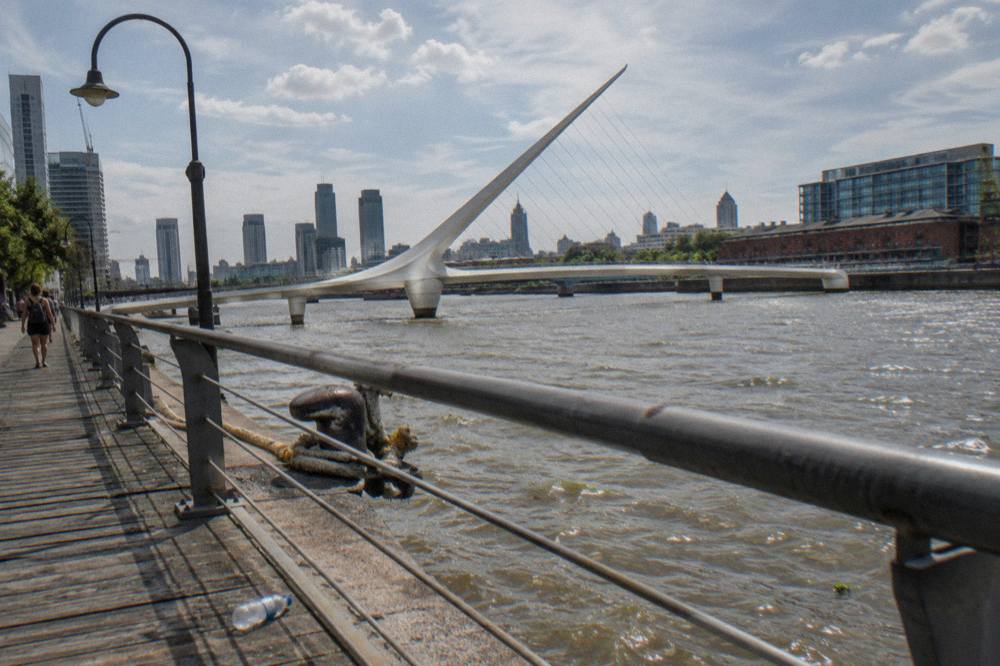
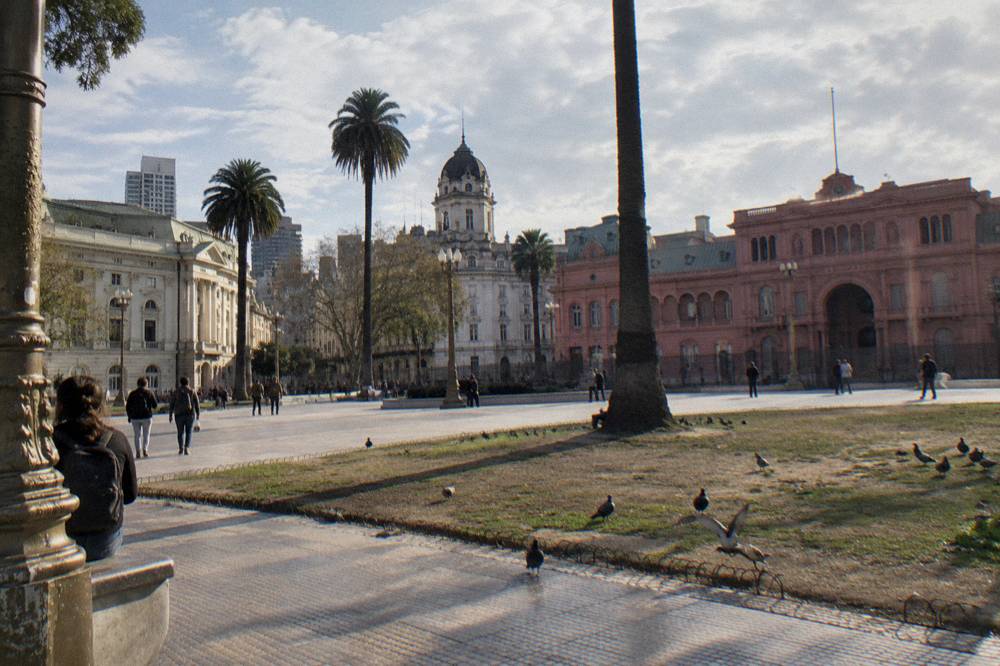
Beyond those anchors, the free side of the district is mostly the walk itself. The promenades along both docks are public, the old port infrastructure is visible from them, and the contrast between the brick warehouse side and the glass residential side is the district's visual theme. Across Avenida Ing. Huergo to the west, the free sights of the historic centre begin: Plaza de Mayo, the Cabildo, the Catedral Metropolitana, all covered in the Plaza de Mayo and Casa Rosada guide. Puerto Madero sits so close to that cluster that the two walk together naturally.
For anyone who wants the free experience explained rather than just walked, the pay-what-you-want walks are the complement. Every walk in this city's directory runs free with a tip at the end, on GuruWalk and, for a handful of listings, on freetour.com. The nearest walks to Puerto Madero meet in the historic centre a short walk west, and a free walking tours overview covers how the model works.
What Costs Money At Puerto Madero?
Everything indoors and everything afloat costs money at Puerto Madero. The dockside restaurants, cafes and businesses are paid, and they are the district's main commercial offer. Boat trips and ferries, including the Tigre and Colonia del Sacramento services, are paid. Beyond the district's edge, the Teatro Colon tours and the Jardin Japones are paid attractions, at ARS 37,000 and ARS 24,000 respectively for non-residents in November 2026. A free walk meets in this neighbourhood: Costanera Sur Nature Walk.
The restaurants deserve an honest paragraph, because they are the district's biggest money trap in the mild sense: Puerto Madero is one of the most concentrated restaurant strips in the city, and a visitor who sits down at every stop will spend accordingly. No figure is needed here, only the structure: the free thing is the walk along the water; the paid thing is the table. The same split applies to the cafes inside the converted warehouses on the western dock. None of this is hidden; it is simply worth knowing before the first menu arrives.
On the water, the position is clearer. The Tigre delta boat rides and the Colonia del Sacramento ferry are both paid services with terminals in or near the riverfront, and neither is part of the free Puerto Madero experience. The Tigre trip in particular is a separate outing with its own logistics, covered in the Tigre question piece. At Puerto Madero itself the boats tied to the docks are mostly scenery.
One category to be careful with is the Ecobici bike share, which appears in some listings as a free or cheap way to ride the reserve's trails. Its current rules and prices are contested between sources, so this site states nothing about them: anyone curious should check the operator's current notice before relying on it. The reserve's trails are walkable in any case, and walking them costs nothing.
Away from the district but within the same day's walk, the paid attractions cluster in Recoleta and Palermo: the Teatro Colon's guided tours, the Jardin Japones, MALBA on its non-Wednesday days. Those belong to their own guides. The point for this article is the boundary: at Puerto Madero, money buys food and transport, never the view.
When Should You Go To Puerto Madero?
Any day the sky cooperates, but the Reserva Ecologica's calendar sets the rhythm: it is closed Mondays, so a Monday visit loses the biggest free sight on the district's edge. In the November to March summer the reserve stays open to 19:00, which pairs well with a late-afternoon walk over the Puente de la Mujer as the towers light up. Winter visits lose that last hour but keep the whole district.
The Monday rule is the one date fact that genuinely changes plans. The docks and the bridge are available every day, but a visitor who saves the reserve for a Monday will find it shut, along with the Cabildo and the Jardin Botanico, which share the same closing day. Tuesday is also a museum day to watch in central Buenos Aires: MALBA, MAMBA and the city museums all close then. Anyone combining Puerto Madero with indoor sights should build around the table below. A free walk meets in this neighbourhood: Costanera Sur Nature Walk.
| Sight | Open | Closed |
|---|---|---|
| Puerto Madero docks and Puente de la Mujer | Always, open public space | Never |
| Reserva Ecologica Costanera Sur | Tue to Sun and holidays, 8:00 to 19:00 in summer | Mondays, 1 May, 25 Dec, 1 Jan, bad weather |
| MALBA | Wed to Mon, Wednesday half price | Tuesdays |
| Museo Casa Rosada | Wed to Sun, 11:00 to 18:00 | Mondays and Tuesdays |
| Cabildo and Jardin Botanico | Varies by season | Mondays |
| PROA and the national museums | Wed to Sun only | Mondays and Tuesdays |
Seasonally, the November to March window is the high-visibility one, and not only for the later closing hour: it is the season when the riverfront is at its most usable and when the city's outdoor calendar fills. The annual November night when museums across Buenos Aires open free of charge, Noche de los Museos, falls in this window and makes a November city visit unusually generous, though individual venues set their own last-entry times. On any given day, the free outdoor nature of the whole Puerto Madero experience means the national weather service's forecast is more decisive than any ticket price.
How Do You Combine Puerto Madero With Other Free Sights?
The natural free route runs west from the Puente de la Mujer into the historic centre: Plaza de Mayo, the Cabildo, the Catedral Metropolitana and the Casa Rosada's free museum are all within one continuous walk. Going the other way, the Reserva Ecologica absorbs a full half-day on its own. North along the riverfront, Parque de la Memoria and the Floralis Generica extend the green chain. A free walk meets close to this area, Costanera Sur Nature Walk.
The classic combination is the westbound one, because the geography does the work. Puerto Madero's western dock ends within walking distance of the Plaza de Mayo cluster, and that cluster is dense with free entry: the plaza itself, the Cabildo, the cathedral, and the Museo Casa Rosada behind the palace, which is free and open Wednesday to Sunday, 11:00 to 18:00. A morning in the reserve followed by an afternoon walking west covers the two best free zones in this part of the city without a single ticket.
The green combination suits a slower day. The reserve trails connect, in effect, to the chain of waterfront parks that runs north from Puerto Madero, and the Floralis Generica, the giant kinetic flower sculpture in Plaza de las Naciones Unidas further north, is another free open public space on the same axis. The free things to do in Palermo guide picks up that chain at its northern end, where the Jardín Botánico and the Parque Tres de Febrero lakes continue the free-outside, paid-inside pattern: the parks and lakes are free, the paddle boats are paid.
For structure, a guided walk is the efficient way to absorb the centre's half of this route. The essential centre walk by Vive Buenos Aires, a three-hour GuruWalk free tour rated 4.84 out of 5 across 1,332 GuruWalk reviews, meets at the Biblioteca del Congreso on Avenida Hipólito Yrigoyen and runs in English and Spanish; it is the longest of the centre walks and a good spine for a first day. Details and meeting-point notes are on the Downtown Intro tour page.
Palermo offers two more pay-what-you-want options from the same GuruWalk shelf. The Palermo Soho Street Art tour, run by the same outfit as the centre walk, is rated 4.91 out of 5 across 161 GuruWalk reviews and meets at Plaza Serrano; it is the natural pick for the murals side of the free city, paired with the street art guide. Its sibling is a parks walk rated 4.91 out of 5 across 53 GuruWalk reviews, meeting at the Jardín Botánico.
The parks walk, Pablo's two-hour English tour of Palermo's green spaces, fits the green combination above: it begins where the Jardín Botanico's gate is, in the same park chain the riverfront leads toward. It runs on GuruWalk, free to join with a tip at the end, and a reservation on the guide's own page costs nothing upfront.
Which Free Walking Tours Meet Near Puerto Madero?
No English walk meets inside Puerto Madero itself, but the surrounding streets are meeting-point territory for several. Closest is a Spanish-only GuruWalk walk that meets at the Puente de la Mujer itself. In the nearby historic centre, the GuruWalk walks meet at the Casa Rosada, the Pirámide de Mayo and the Cabildo, and freetour.com's Free City Center Walk meets at the Gate of the National Congress. All are pay what you want.
The one walk with a genuine Puerto Madero meeting point is a Spanish-language affair: the Monserrat Viceroyalty History walk, additional on GuruWalk, which meets at the Puente de la Mujer before heading into the older city. It runs in Spanish and Italian, lasts two and a half hours, and has no reviews shown yet, so this site makes no claim about it beyond its listing facts. For an English-speaking visitor it is less useful than the centre walks, but it confirms the bridge's status as a recognised gathering point. One of the free walks starts in this part of the city: Free City Center Walk.
The alternatives all sit a short walk west, in the Plaza de Mayo and Congress stretch. The trilingual First-Timer Welcome walk by Buenos Aires Horizon Tours meets at the Casa Rosada and is rated 4.92 out of 5 across 743 GuruWalk reviews. WalkBa Tours' one-hour-forty-five-minute English history walk meets at the Congress Monument. The freetour.com Free City Center Walk, listed on freetour.com, meets at the Gate of the National Congress and shows a 9.6 rating out of 10 across 10,227 reviews shown on its freetour.com listing; those counts aggregate other sources and are not comparable with GuruWalk figures.
| Walk | Platform | Meets at | Language | Duration |
|---|---|---|---|---|
| Monserrat Viceroyalty History | GuruWalk | Puente de la Mujer | Spanish, Italian | 2 hours 30 minutes |
| First-Timer Welcome, Trilingual | GuruWalk | Casa Rosada, Plaza de Mayo | English, Spanish, Portuguese | 2 hours 30 minutes |
| Short City Center History Walk | GuruWalk | Congress Monument, Plaza del Congreso | English | 1 hour 45 minutes |
| Downtown Intro, 3 Hours | GuruWalk | Biblioteca del Congreso | English, Spanish | 3 hours |
| Free City Center Walk | freetour.com | Gate of the National Congress | English, Spanish | 2 hours 30 minutes |
A note on how these walks run, since the model confuses first-time visitors: the walk is free to book and free to join, the guide works for tips, and the reservation is made through the operator's live listing, on GuruWalk or freetour.com depending on the walk. This site is not affiliated with either platform; every walk page here describes an independent local guide's own listing. The how free walking tours work piece answers the mechanics in full, including the tipping question.
Mistakes That Trip People Up At Puerto Madero
The recurring mistakes are simple ones: saving the Reserva Ecologica for a Monday, when it is closed; assuming the whole free city shares Puerto Madero's no-conditions policy, when the museums' Wednesday free entry is for Argentine residents with DNI only; and planning a Puerto Madero day around a direct Retiro to Tigre train that is currently not running. Each of these is checkable in advance and each one quietly breaks an itinerary. A free walk meets in this neighbourhood: Costanera Sur Nature Walk.
The Monday mistake is the most common because Puerto Madero itself never closes. A visitor can walk the docks and the bridge perfectly happily on a Monday and only discover at the reserve gate that the day's headline stop is shut. The same Monday applies to the Cabildo and the Jardin Botanico, so a Monday in this part of the city is best treated as a docks-and-bridge day.
The "free Wednesday" mistake travels with visitors across the city. At Puerto Madero there is nothing to trip over, because nothing has a free day: it is simply free. But one street west, the museums follow several different Wednesday regimes, and treating them as one generic free day leads to disappointment at the ticket desk. The museum free days question sets out the three regimes plainly.
The Tigre mistake is a planning-level one. Some itineraries pair a Puerto Madero morning with a Tigre afternoon, reached by a direct train from Retiro. The official Tigre page states that the direct Retiro to Tigre service is interrupted, with the Mitre line to Maipu plus the Tren de la Costa connection, or colectivos, as the working alternatives; the current operator notice should be checked before travelling. The delta itself is a separate outing, and its free-versus-paid split, free market against paid boats, is covered in the Tigre piece linked above.
Finally, a safety note in plain terms, paraphrased from the UK and Canadian government travel advice for Argentina: petty theft such as pickpocketing occurs in busy tourist areas, and in La Boca visitors should stay on the main tourist streets and avoid the area after dark. Puerto Madero itself carries no specific warning in that advice, but the general caution about busy waterfront crowds is the standard one for any city dockland.
Common Questions About Puerto Madero
Is Puerto Madero free to visit?
Yes, entirely. The docks, the promenades and the Puente de la Mujer are open public space with no entry, no hours and no residency condition. Money at Puerto Madero buys food, boats and ferries, never the district itself.
Is the Puente de la Mujer free?
Yes. The footbridge is a free open public space and can be crossed at any time. There is no viewing platform or ticketed element; it is simply one of the city's most photographed bridges, and photographing it costs nothing either.
Is the Reserva Ecologica Costanera Sur free?
Yes, free for all visitors, with no resident-versus-foreigner split. It opens Tuesday to Sunday and holidays, 8:00 to 19:00 in the November to March summer schedule, and 8:00 to 18:00 in winter. It closes Mondays, on 1 May, 25 December and 1 January, and in bad weather.
What costs money at Puerto Madero?
Everything indoors and afloat: the dockside restaurants and cafes, the boat services, and the Tigre and Colonia del Sacramento ferries. No free walk covers any of these, and the paid tango shows and stadium experiences elsewhere in the city are separate purchases entirely.
Are there free walking tours at Puerto Madero?
No English walk meets inside the district, but walks gather all around it. A Spanish-only GuruWalk walk meets at the Puente de la Mujer itself, and English-language pay-what-you-want walks meet in the nearby historic centre, at the Casa Rosada, the Congress and the Biblioteca del Congreso.
Can you walk from Puerto Madero to Plaza de Mayo?
Yes, and it is one of the best free combinations in this part of the city. The western dock leads toward the Plaza de Mayo cluster, where the plaza, the Cabildo, the Catedral Metropolitana and the free Museo Casa Rosada are all within a single walk, the museum open Wednesday to Sunday, 11:00 to 18:00.